

Figuring out how much do movers cost for a studio apartment is one of the first real budget questions you’ll face as a first-time studio renter. You’re not moving a whole house — a studio is usually one room of a few hundred square feet — so the bill should be small. But “small” still spans a wide range: a few hundred dollars on the low end to well over a thousand in expensive cities, depending on where you live and who you hire.
This guide breaks down what professional movers actually charge for a studio move in 2026, what makes your quote climb or drop, and — the part most cost guides skip — every realistic DIY alternative with real numbers attached. Whether you’re collecting your first quotes or weighing a truck rental, you’ll leave with figures you can plug into a budget.
As of 2026, hiring movers for a local studio apartment move typically costs $300–$1,000, with most first-timer moves landing $350–$600. DIY alternatives run far less: a local truck rental all-in can total $75–$250, labor-only help around $300–$360, and a portable container roughly $150–$600.
Summary

Local movers price a studio by the hour — usually a two-person crew with a truck, with a 2–3 hour minimum plus a travel fee. Where you live matters more than what you own: current 2026 city data puts studio moves around $330–$490 in mid-size markets and $500–$850+ in expensive metros. This article walks through exactly how that pricing works, the five factors that push your quote up or down, the hidden fees that surprise first-timers, and four ways to move cheaper (truck rental, portable container, labor-only help, and friends). It closes with a side-by-side comparison worksheet and a checklist for getting quotes you can trust.
1. The Short Answer

If you only need the number: a local full-service studio move runs $300–$1,000 as of 2026, and most first-time renters in average-cost cities land in the $350–$600 band. Expensive metros (New York, Seattle, San Francisco) skew toward the top; smaller and Southern/Midwestern markets skew toward the bottom.
But full-service movers are only one option. Here’s the full menu of studio-moving paths with as-of-2026 typical ranges:
| Move option | Typical local studio cost (as of 2026) |
|---|---|
| Full-service movers (crew + truck) | $300–$1,000 |
| Labor-only help + your rental truck | ~$400 combined |
| Portable moving container | $150–$600 |
| DIY truck rental, all-in | $75–$250 |
| Friends + your own car | $50–$100 (supplies + gas + pizza) |
Every one of these ranges is detailed below, with what drives the low vs. high end.
2. How Movers Price a Studio

Local moves — generally anything under about 50–100 miles — are priced by the hour, not by weight. For a studio, the standard setup is a two-person crew with one truck. As of 2026, that crew typically bills:
- $85–$195 per hour, depending on the market (cheaper in Southern and Midwestern cities, pricier in major coastal metros)
- A minimum of 2–3 hours, even if your move is quick — the crew has to be dispatched, fueled, and driven to you
- A travel fee or fuel surcharge on top of the hourly rate, often around $50–$100
A studio move usually takes 2–5 hours total: a couple of hours loading, drive time between addresses, then unloading. So the math for a straightforward studio move is roughly: hourly rate × hours on the clock + travel fee = your bill.
What’s normally included in that hourly rate: the truck, basic moving equipment (dollies, furniture pads, straps), and the crew’s labor. What’s not included unless you pay extra: packing your boxes, packing materials, and any specialty handling. Ask every company what “the rate” covers before you compare numbers — two identical hourly quotes can hide very different final invoices.
3. Full-Service Price Ranges

City-by-city data published in 2026 shows how much geography matters. Studio averages from multiple moving-cost sources, all as of 2026:
| Market | Studio local move (as of 2026) |
|---|---|
| Budget-friendly metros (e.g., Atlanta, smaller markets) | $300–$550 |
| Mid-size cities (e.g., Chicago, California averages) | $350–$650 |
| Expensive metros (NYC, Manhattan, Seattle) | $450–$1,000+ |
A few concrete data points behind those bands, all published or updated in 2026: studio moves average about $331 in Atlanta and $369 in Chicago, around $442–$486 in California and Manhattan, and a $538 median in Brooklyn based on real completed moves. A national mover database puts the typical full-service local studio move at about $880–$1,220 for roughly 50 miles — that’s the high end, and it shows what can happen when access is difficult or you’re in a pricey market.
Your editor should re-check these before publishing, since mover pricing moves with fuel costs and local demand — but these ranges, all marked as-of-2026, give you an honest starting point instead of the vague “a few hundred dollars” most guides offer.
4. What Moves Your Price

Two studios with identical furniture can produce quotes hundreds of dollars apart. The five factors that do it:
Access. This is the biggest one. Elevator-to-elevator is the cheapest scenario. Walk-ups, long hallways, shared elevators you have to wait for, and long carries from the truck to your door all add crew time — and on hourly pricing, time is money. Some companies also charge a per-flight stair fee, commonly around $50–$75 per flight as of 2026.
Distance between addresses. Ten miles vs. thirty miles changes drive time and fuel. It won’t double your bill, but it nudges it.
How much stuff you have. A minimally furnished studio (bed, small dresser, boxes) moves faster than a packed one with a sectional, bookshelves, and a bike collection. Decluttering before moving day is one of the cheapest ways to lower a mover quote.
When you move. Summer, the first and last days of the month, and weekends cost more because demand peaks. If your lease gives you any flexibility, a mid-month Tuesday can be noticeably cheaper than a Saturday at month-end.
Packing add-ons. If you want the crew to pack your kitchen, closets, and breakables, packing labor runs around $60/hour as of 2026, and materials are extra. On a studio this can add a few hundred dollars — which is why packing yourself is the single easiest place to save if you have the time.

The complaints about movers rarely involve outright scams — most often, it’s costs nobody explained. Before you book, ask about each of these:
- Travel fee / truck fee. Often a flat $50–$100, sometimes billed as the first hour. Get it in writing.
- Fuel surcharge. Commonly around $75 as of 2026, sometimes folded into the travel fee.
- Packing materials. Stretch wrap, mattress bags, and extra boxes the crew uses get billed to you. Ask the per-item price.
- Stair and long-carry fees. If the building has no elevator or the truck can’t park close, confirm the fee structure in advance.
- Valuation coverage. Basic coverage (often called “released value”) is usually included free but only pays a token amount per pound if something breaks. Full-value protection costs extra — worth considering if you own anything you’d actually replace.
- Cancellation and rescheduling fees. Know the deadline for penalty-free changes, in case your lease dates shift.
- Tips. Not a fee, but budget for it: tipping each mover $20–$40 for a studio job is a common custom, in cash.
The practical defense: get a written binding or not-to-exceed estimate that lists every one of these line items, so moving day holds no surprises.
6. DIY: Renting a Truck
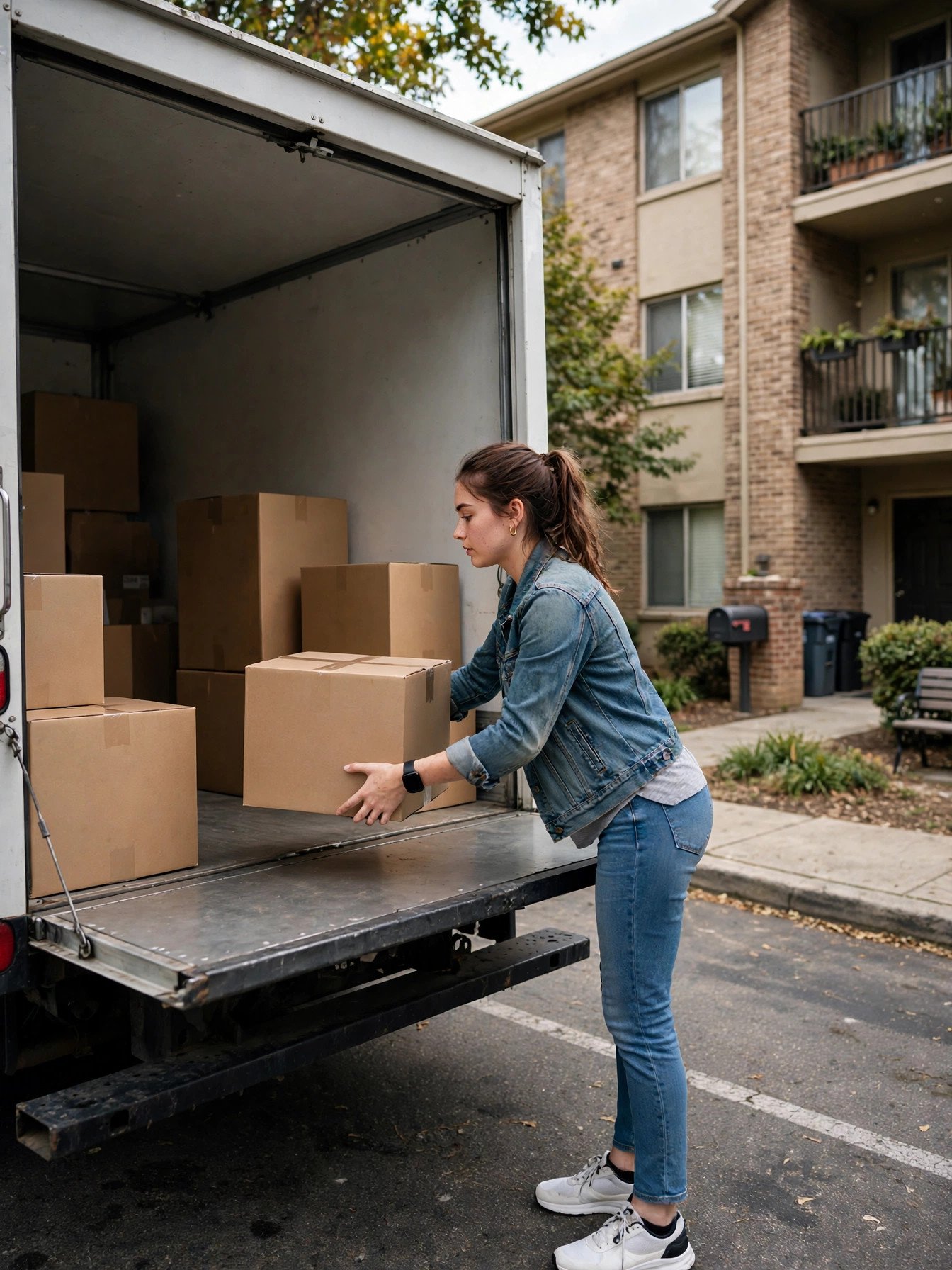
For a studio, this is the cheapest serious option — and the one most first-timers underestimate how cheap it can be. A studio’s contents fit in a cargo van or a 10-foot truck, the smallest rentals available.
As-of-2026 pricing for local rentals:
- The big national truck-rental brands advertise base rates from $19.95/day for a cargo van, pickup, or 10-ft truck — but that number excludes mileage, fuel, fees, and taxes.
- Local mileage runs around $0.47–$0.99 per mile depending on the company, as of 2026.
- Home Depot’s truck rental starts around $29 with flat-rate pricing and no mileage fees — often the simplest deal for a same-day local move.
- One cost database puts an all-in local 1-bedroom truck rental at about $105 (base + mileage + fuel).
Putting it together: a local studio DIY move typically totals $75–$250 all-in (base rate + mileage + fuel + basic supplies). For a regional one-way move of a few hundred miles, expect roughly $290–$350 for a 1-bedroom-size truck, and longer one-way trips can run $1,000+.
The honest caveat: you’re the crew. Budget for friends’ help, and don’t forget packing supplies (boxes, tape, a mattress bag), which can add $50–$100 if you’re buying everything new.
7. DIY: Portable Container
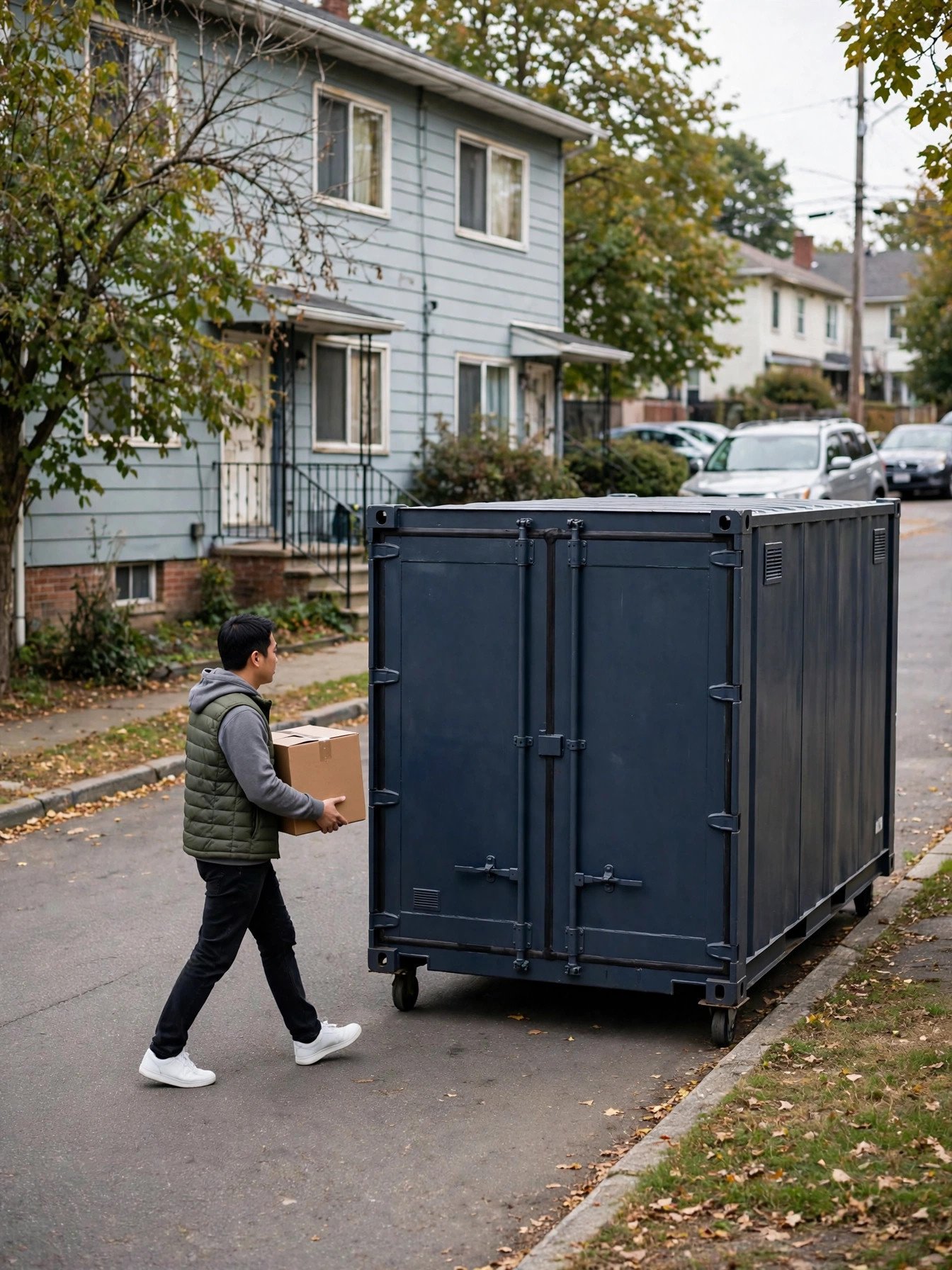
A portable container company drops a weatherproof box at your place, you load it on your own schedule, and they drive it to your new address (or hold it in storage if your dates don’t line up).
As of 2026, local container moves for a 1-bedroom run roughly $150–$600; a studio typically lands at the lower end of that range since it needs the smallest container. This option shines in two first-timer scenarios:
- Your lease dates don’t line up. If you have to be out Friday but can’t move in until Monday, the container doubles as storage — no separate storage-unit rental.
- You can’t block out one frantic day. Load over a few evenings after work instead of cramming everything into Saturday.
Checklist before booking: confirm the container fits in your building’s parking area or on the street (some cities require a permit), ask about the included rental window (usually a few days to a month), and confirm whether the price includes delivery, pickup, and any storage days.
8. DIY: Labor-Only Help

The middle path: you rent the truck, and you hire movers for the muscle — loading, unloading, or both. No truck from them, no driving, just experienced hands for the heavy part.
As-of-2026 studio numbers:
- Labor-only loading and unloading for a studio runs roughly $296–$362 according to one national mover cost database.
- Two helpers can run around $135 for a short job through labor marketplaces, as of 2026.
- Pairing labor-only help with your own local truck rental brings the typical combined total to about $403.
This is often the sweet spot for a first-time studio renter: you save hundreds vs. full-service, but someone who knows how to carry a couch down stairs does the risky part. Book through a marketplace that shows reviews, and confirm the minimum (usually 2 hours) and whether they bring their own equipment like dollies and straps.
9. The Full Comparison

Here’s everything side by side, as illustrative as-of-2026 totals for a typical studio move — elevator building, 10 miles across town, you packed your own boxes:
| Line item | Full-service movers | Labor-only + your truck | Portable container | DIY truck rental | Friends + car |
|---|---|---|---|---|---|
| Labor | $450 | $300 | $0 | $0 | $0 |
| Truck / container | included | $100 | $250 | $140 | $0 |
| Mileage + fuel | included | included in truck | included | included in truck | $30 |
| Supplies | $0 (you packed) | $0 (you packed) | $0 (you packed) | $60 | $50 |
| Tip / thank-you | $60 | $40 | $0 | $0 | $30 (pizza) |
| Illustrative total | $510 | $440 | $250 | $200 | $110 |
These aren’t quotes — they’re worked examples built from the as-of-2026 ranges above, so your real numbers will differ by market. But the shape of the decision holds:
- Hire full-service if you have zero help, heavy furniture, a tight schedule, or a bad back. For a studio it’s the priciest option, but sometimes it’s the only realistic one.
- Labor-only + truck if you can drive a box truck but don’t want to haul the couch. Best value-for-effort in most cities.
- Container if your dates are messy or you want to load slowly.
- DIY truck if you’re on the tightest budget and have at least one strong friend.
- Friends + car only if your studio is lightly furnished — three car trips beat one overloaded one.
Studio Move Budget Worksheet
- Quote A (company): ____ | hourly rate ____ | minimum ____ | travel fee ____ | est. total ____
- Quote B (company): ____ | hourly rate ____ | minimum ____ | travel fee ____ | est. total ____
- Quote C (company): ____ | hourly rate ____ | minimum ____ | travel fee ____ | est. total ____
- Truck rental option: base $____ + mileage $____ + fuel $____ = $____
- Container option: $____ (delivery + rental days + pickup)
- Labor-only option: helpers $____ + truck $____ = $____
- Packing supplies budget: $____
- Tips / thank-you budget: $____
- My move budget ceiling: $____
10. Getting Quotes That Stick

Three quotes is the rule — and for a studio, it’s a 20-minute job, not a research project:
- Describe the same move to all three companies. Same addresses, same inventory, same date. Otherwise you’re comparing different jobs.
- Ask for a video or in-person survey. A company that quotes sight-unseen is guessing; a 10-minute video walkthrough produces a quote that holds.
- Get every fee in writing. Ask specifically: minimum hours, travel/fuel fee, stair fee, materials pricing, and cancellation terms. If it’s not in the estimate, assume it’s extra.
- Prefer binding or not-to-exceed estimates. “Binding” means the price is the price; “not-to-exceed” means it can only go down. Both beat an open-ended hourly guess.
- Verify the basics. For interstate moves, the company needs a USDOT number; for local moves, check your state’s licensing requirements. Ask your building whether they require a certificate of insurance (COI) from movers — many apartment buildings do, and it’s easier to arrange a week ahead.
- Be wary of big upfront deposits. Reputable local movers typically ask for little or nothing down; a demand for a large deposit before moving day is a red flag.
- Book 2–4 weeks out, and pick an off-peak day if you can — mid-month weekdays are the cheapest slots on the calendar.
For more on the full cost picture of moving into your first place — deposits, fees, and setup costs beyond the movers — see our guide to first apartment hidden fees to budget for. And if you’re still mapping the whole move-in budget, the Budgeting & Renting Costs section has the rest of the series.
Frequently Asked Questions
Is $800 too much to pay for a studio move?
In an expensive metro or with difficult access (walk-up, long carry), $800 is within the normal as-of-2026 range for full-service movers. In a cheaper market, it’s high — get two more quotes before accepting it.
Can I move a studio apartment by myself with just a car?
If your studio is lightly furnished — mostly boxes, a mattress, and small furniture — yes, with multiple trips. The breaking point is usually the bed frame, couch, and dresser: if those won’t fit in your car, a one-day truck rental (often under $150 all-in locally) beats five car trips.
How long does it take movers to move a studio?
Typically 2–5 hours door to door: a couple of hours loading, drive time, then unloading. Elevator buildings and pre-packed boxes land at the short end; walk-ups and loose, unpacked stuff land at the long end.
Should I hire movers or rent a truck for my studio?
Hire movers if you have no help, heavy furniture, or a tight timeline — budget $350–$600 in most markets as of 2026. Rent a truck if you have at least one helper and want to spend $75–$250 instead. Labor-only help plus your own truck splits the difference at around $400.
Do movers charge by the hour or a flat rate for a studio?
Local studio moves are usually hourly, with a 2–3 hour minimum. Some companies offer binding flat rates instead — those are worth asking about, since a flat rate can’t creep upward on a slow day.
What’s the cheapest time to move?
October through April is the off-season, and mid-month weekdays are the cheapest days. Summer weekends at month-end are peak pricing — sometimes noticeably more for the same job.
Do I have to tip my movers?
It’s customary but not mandatory. For a studio move, $20–$40 per mover in cash is common as of 2026, more if the crew handled stairs or went above and beyond.
My studio is a third-floor walk-up. How does that change the cost?
Expect more hours and possibly a per-flight stair fee ($50–$75/flight is common as of 2026). This is exactly the scenario where labor-only help shines: experienced carriers handle the stairs while you keep the truck cost low.
Conclusion

Knowing how much do movers cost for a studio apartment turns a stressful unknown into a line item: roughly $300–$1,000 for full-service pros as of 2026, or $75–$400 if you go DIY with a truck, container, or labor-only help. Get three written quotes, watch for the fees nobody mentions upfront, and pick the option that fits your budget and your back. If this breakdown helped you plan your move, save it or share it with a friend who’s studio-hunting too.

Maren started MyFirstLease after a rough first lease taught him everything the internet didn’t. He covers the logistical side of renting — move-in checklists, utilities, and the unglamorous first-week stuff nobody explains — and oversees everything published on the site.